Dry optics all night, from a box smaller than a deck of cards.
A four-channel Wi-Fi dew controller that shows up in N.I.N.A., KStars and SharpCap on its own and holds each lens a few degrees above the dew point. No driver, no cable to the laptop. First batch planned for spring 2027.
Built for the way you already image.
Most dew controllers are a knob and a fuse. This one is a network device that your imaging software finds, reads and controls, so heat follows the weather instead of a guess you made at dusk.
Finds its own way into your software
ASCOM Alpaca over Wi-Fi with automatic discovery, an INDI driver for KStars and Ekos, and a web page that works from any phone. Nothing to install, nothing plugged into the laptop.
Tracks the dew point, not a knob
A probe under each strap and an ambient temperature and humidity sensor give the controller the real dew point. It keeps the glass two to three degrees above it and backs off as the night warms.
Enough current for a big Newtonian
Up to 2 A (24 W) on each of the four RCA channels from your 12 V supply, with reverse-polarity and surge protection. Every strap you already own plugs straight in.
On the telescope and out of the box.
Concept images of the first-batch design, generated from our 3D model. Not photos of a finished unit yet; colours, connector layout and the box may still change after beta.
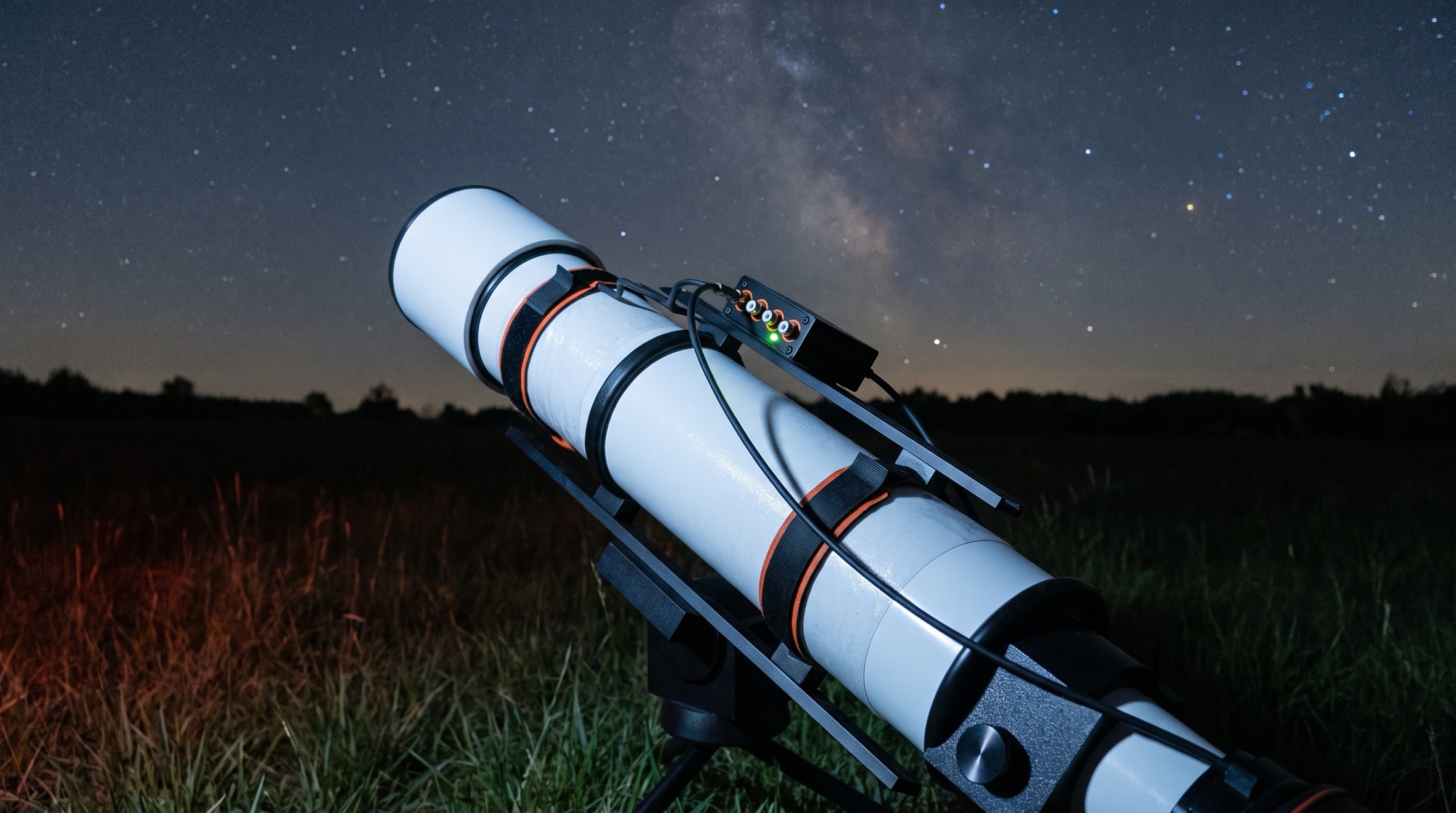
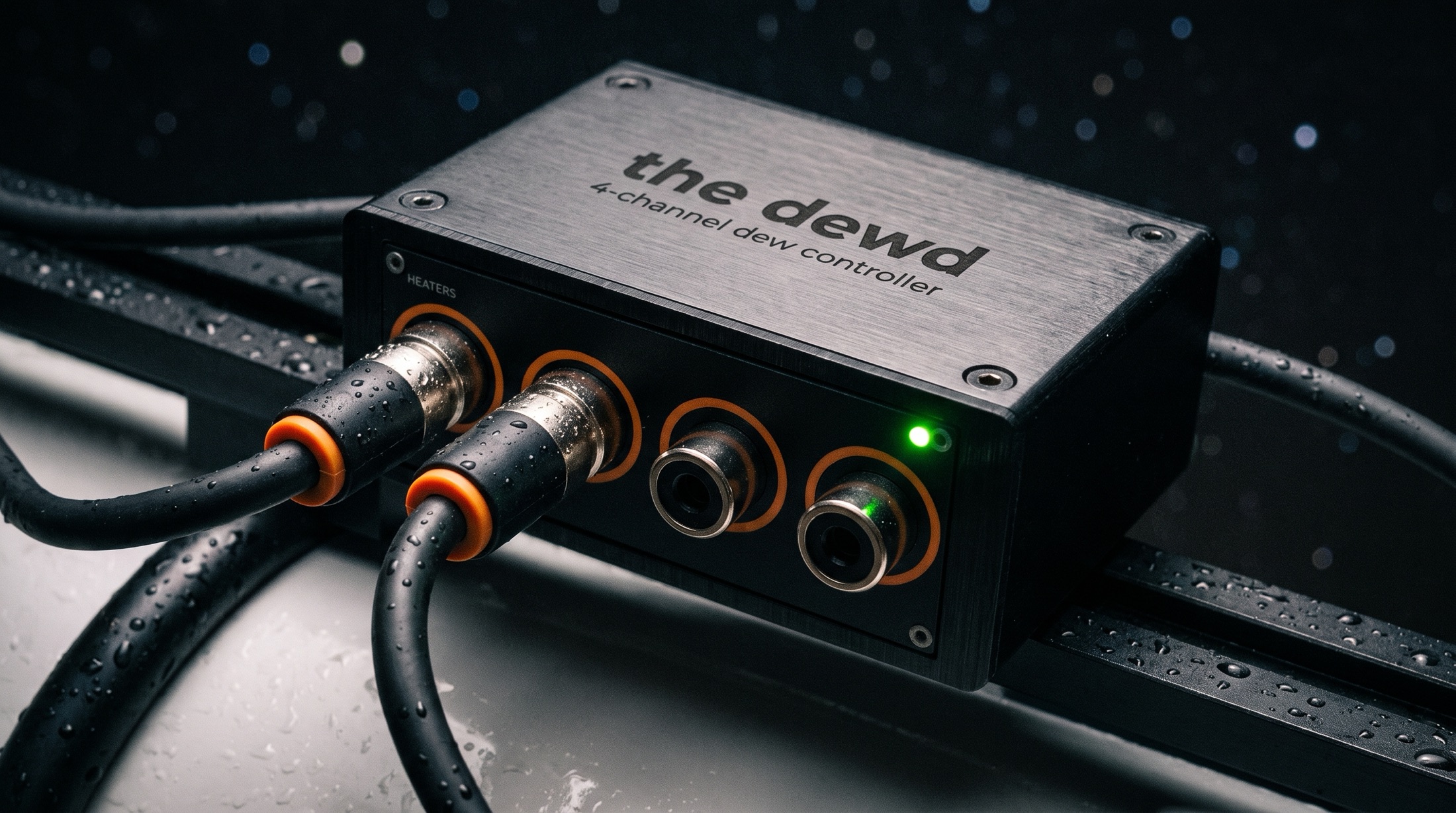
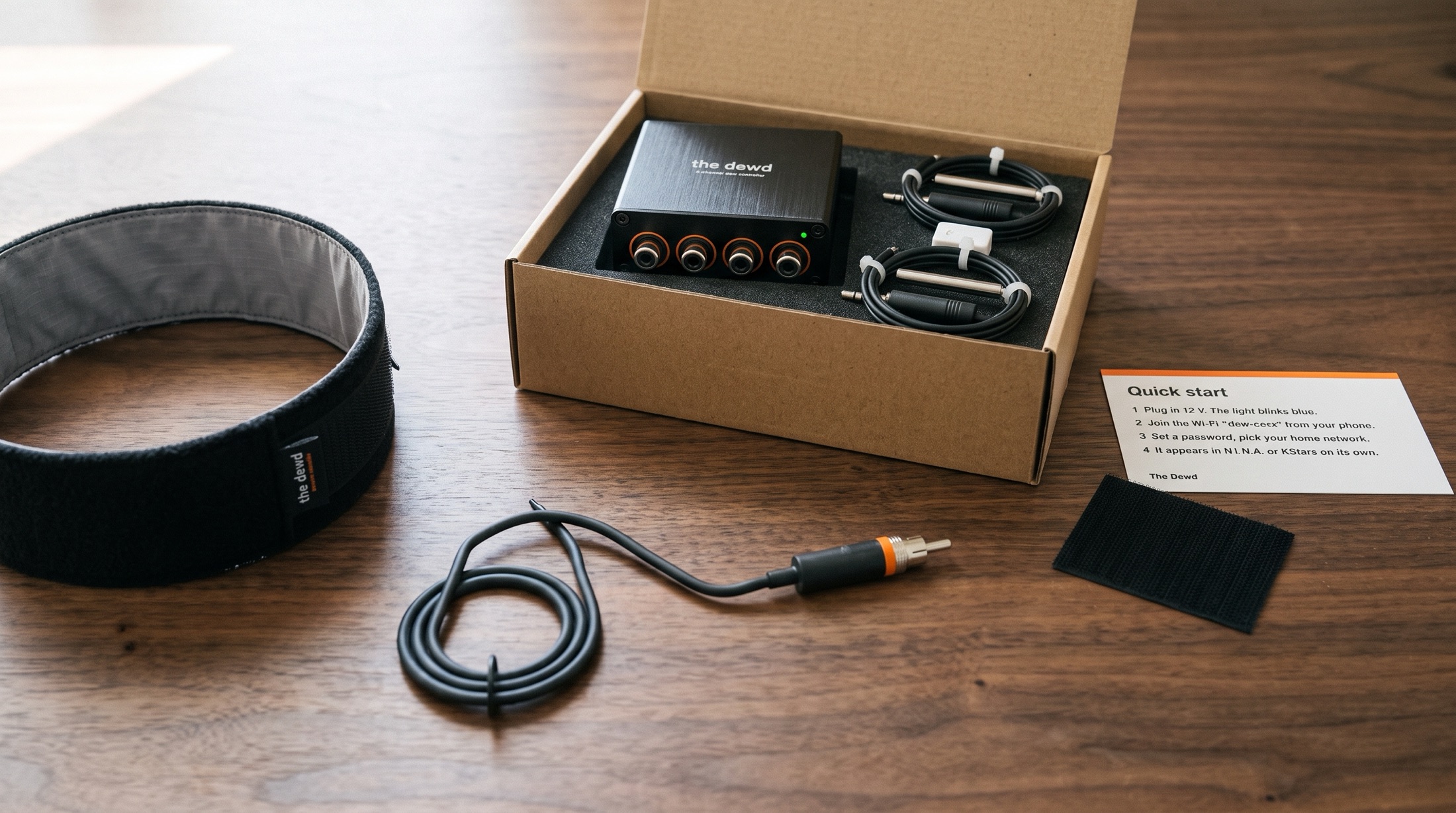
Why it is this small.
Every gram on the tube ring is a gram your mount has to balance, and every centimetre is a cable that snags. The heater jacks sit on the front, everything else on the back, and the box shrinks to the width of four RCA sockets.
- Body
- 60 × 54 × 23 mm
- Weight
- about 70 g with end panels
- Material
- anodised aluminium extrusion, machined end panels
- Front
- 4 RCA heater outputs, status light
- Back
- 12 V in, USB-C, 2 probe jacks, ambient sensor port
- Mounting
- hook-and-loop pad in the box, finder-shoe foot optional
Two probe jacks instead of four keeps the back panel clean. Each jack is a 1-Wire bus, so a Y-lead runs two probes from one socket when you want a sensor under every strap.
Specifications
Planned figures for the first batch. Anything that changes during beta testing will be listed here.
- Heater outputs
- 4 × RCA, 2 A (24 W) each, 8 A total, pulse-width modulated at 100 Hz, short-circuit protected per channel
- Power input
- 12 V DC, 5.5 × 2.1 mm barrel, centre positive, reverse-polarity and surge protected, 8 A fuse
- Probes
- 2 × 3.5 mm jacks, DS18B20 digital sensors, up to 4 probes with Y-leads
- Ambient sensor
- SHT40 temperature and humidity on a 1 m lead, weather-service fallback when unplugged
- Control
- ASCOM Alpaca Switch device, INDI driver, browser UI, USB-C serial for setup
- Modes
- dew-point tracking, ambient offset, manual per channel
- Wi-Fi
- 2.4 GHz, joins your network or opens its own hotspot in the field
- Updates
- over the air, or from the browser over USB-C, no app required
- In the box
- controller, two probes, ambient sensor, hook-and-loop pad, quick-start card
- Price
- planned €119 incl. VAT, €99 for the launch list
- Warranty
- 2 years, repairable, spare end panels and jacks available
- Compliance
- CE, RoHS, WEEE registered in Germany
Where the project stands
This is a one-person hardware company in Berlin. The plan below is honest about what is done and what is not.
- Prototype boards
ESP32 prototype on the bench, Alpaca discovery tested in N.I.N.A. and KStars, first assembled boards ordered.
- Ten beta units
Hand-built units go to launch-list members in cold, wet places. Their feedback sets the final firmware.
- Testing and CE
Electromagnetic compatibility and radio tests at an accredited lab, declaration of conformity, WEEE registration.
- First batch of 50
Assembled and tested in Berlin, shipped to the launch list first, then to EU dealers.
Questions people ask
Does it work with an ASIAIR?
No. The ASIAIR only talks to ZWO hardware. The controller works with any software that speaks ASCOM Alpaca or INDI: N.I.N.A., KStars and Ekos, StellarMate, SharpCap, APT and Voyager, plus its own web page on any phone.
Which dew straps can I use?
Any 12 V strap with an RCA plug, which is nearly all of them: Kendrick, Dew-Not, Astrozap, Lacerta, Omegon and the no-name ones. Each channel delivers up to 2 A (24 W): full power for straps up to 10 inches. Bigger straps still work; the controller measures their current and caps the duty cycle to stay within the jack rating (about 75 % for an 11-inch strap).
Do I have to use the sensors?
No. Without sensors it is a four-channel manual controller with a web UI. Plug in the ambient sensor and the probes and it switches to dew-point tracking per channel.
What powers it?
Your existing 12 V supply or battery through a standard barrel plug. The controller itself draws under 1 W; the rest is whatever your straps use.
Where is it made?
Designed in Berlin. Circuit boards are assembled by a contract manufacturer, final assembly and testing of every unit happens in Berlin. Enclosure and end panels come from EU suppliers.
What happens with my email address?
It goes on a list that gets one message when beta units are ready and one when the first batch ships. It is never shared or sold, and a reply with "delete" removes it.
Be on the list when the first fifty ship.
Founder price of €99 for everyone who signs up before the first batch, and the ten beta units go to people on this list.